
Most AI agent systems can run. Can they prove what they did?
AI systems are becoming autonomous. The next challenge isn't execution — it's proving what happened.
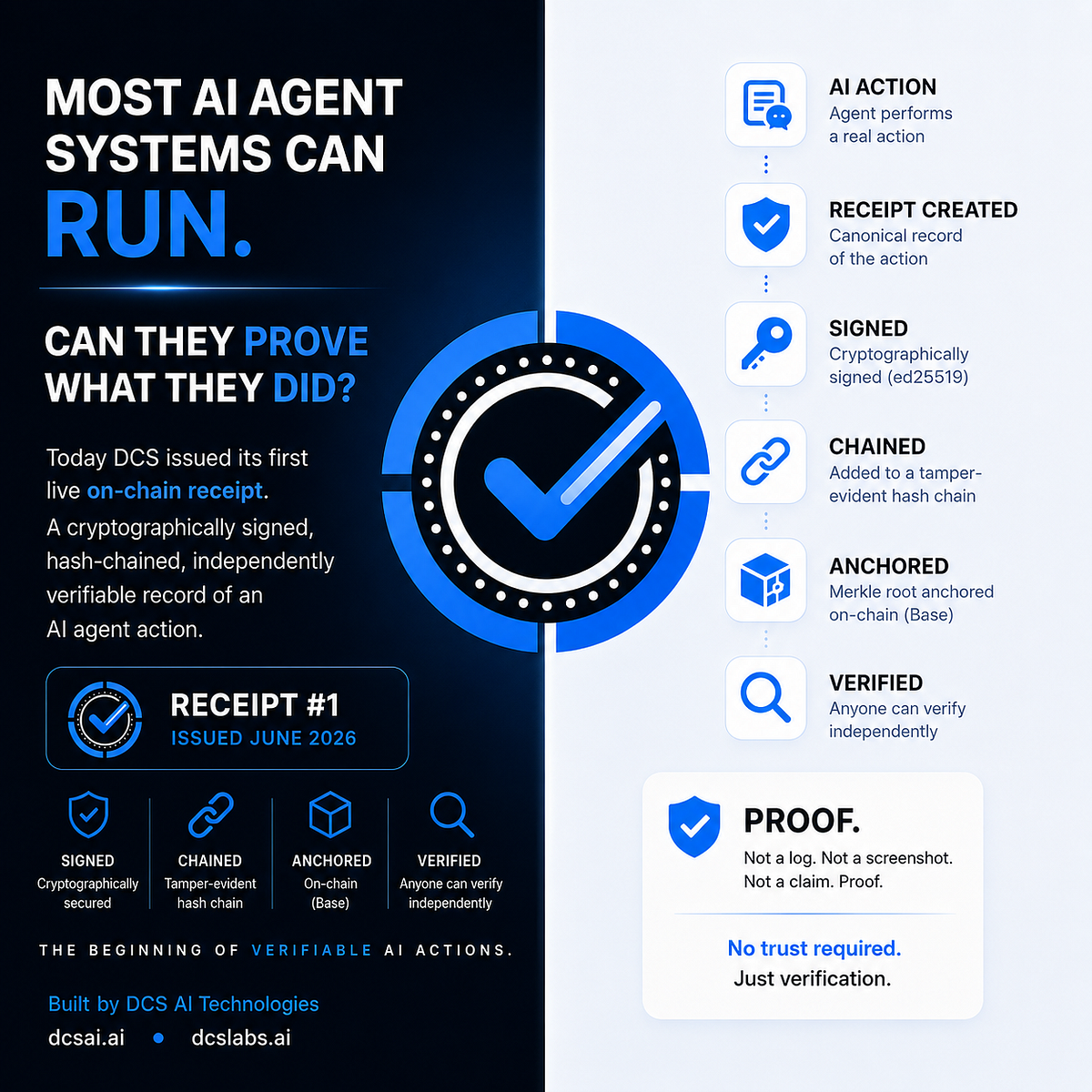
Artificial intelligence is rapidly moving from generating content to taking real actions. AI agents can already:
- Access systems
- Call APIs
- Generate content
- Execute workflows
- Trigger business processes
- Make decisions
As these systems become more autonomous, a new question emerges:
Can you prove what an AI agent actually did?
Most organizations assume the answer is yes. In reality, the answer is often no.
The problem with logs
Today, most AI systems rely on logs. When someone asks what happened, who initiated the action, was the record modified, or can an auditor independently verify it — the typical response is simple: “check the logs.”
The problem is that logs require trust. You must trust the operator, the database, the infrastructure, and the organization maintaining the records.
For many use cases, that is acceptable. For others, it is not. As AI systems become responsible for more important actions, trust alone becomes a weak foundation.
Trust is becoming a bottleneck
AI systems are becoming more powerful every year. The challenge is no longer whether AI can perform tasks. The challenge is accountability.
As agents gain access to tools, workflows, financial systems, and operational environments, organizations need better answers to questions such as:
- What action was taken?
- Why was it taken?
- Can the action be independently verified?
- Can the record be audited later?
Without reliable proof, trust becomes a bottleneck. With verifiable records, trust can become a property of the system itself.
What is a verifiable receipt?
A receipt is a cryptographic record of an action. Instead of simply storing an event in a database, the action produces a receipt that can later be verified independently.
A verifiable receipt answers questions such as:
- What happened?
- When did it happen?
- Which system produced it?
- Has the record changed since it was created?
Unlike a traditional log, a receipt is designed to be verified without trusting the issuer.
From trust to verification
Historically, digital systems have operated on trust. Trust the company. Trust the database. Trust the report. Trust the screenshot. Trust the export.
Verification changes the model. Instead of asking users to trust an organization, the system provides evidence that can be independently checked.
The stronger the evidence, the less trust is required.
The beginning of verifiable AI actions
Today was a milestone for DCS. After months of building, testing, breaking things, rebuilding, and verifying every assumption, DCS generated its first live verifiable AI-action receipt.
For us, this milestone is not about a single receipt. It represents the beginning of a much larger journey — a future where AI actions are:
- Signed
- Chained
- Auditable
- Independently verifiable
Not just executable. Provable.
What comes next
One receipt demonstrates the concept. Scale proves the infrastructure.
The next milestones are straightforward:
- First 100 receipts
- First 10,000 receipts
- First 100,000 receipts
- First 1,000,000 receipts
Because the future of AI will not be built on trust alone. It will be built on systems that can prove what happened.
Don't take our word for it
Every DCS receipt is signed (Ed25519), hash-chained, and anchored on Base — verifiable by anyone, with no account.